
Marcus Criminal History Checks
Start close to the event. A Marcus officer's narrative remains with the Marcus Police Department, not with the courthouse clerk. The clerk maintains the criminal case only after a complaint, trial information, or other charging paper is filed. The Cherokee County Jail is the custody source when a person is transported for booking. Iowa DCI then supplies a separate statewide history product based on information submitted by law enforcement, courts, and corrections agencies.
This five-part route keeps unlike records from being mistaken for each other:
- Contact Marcus Police for an incident or arrest record made by a Marcus officer.
- Describe the date, time, place, report type, and known incident number in a written request.
- Call the Cherokee County Jail for current custody or booking questions because Marcus has no city jail.
- Search Iowa Courts Online, then ask the Cherokee Clerk for public documents or an older file.
- Order the Iowa DCI name and birth-date check when the question concerns releasable statewide Iowa history.
The channels are cumulative, not interchangeable. One may have a record that another does not.
Marcus Police Record Contacts
Marcus publishes unusually direct police contacts for a small city. Police Chief Brian Flikeid can be reached through the office at 712-376-4618, the listed cell at 712-261-3056, or mpd1830@midlands.net. Emergency calls still belong with 911. The cell number does not turn an ordinary record request into an emergency, but it gives Marcus residents another way to identify the right custodian when the office line does not answer.
The official Marcus city government page shows the local police and City Hall contact route. The captured page below preserves that public source.
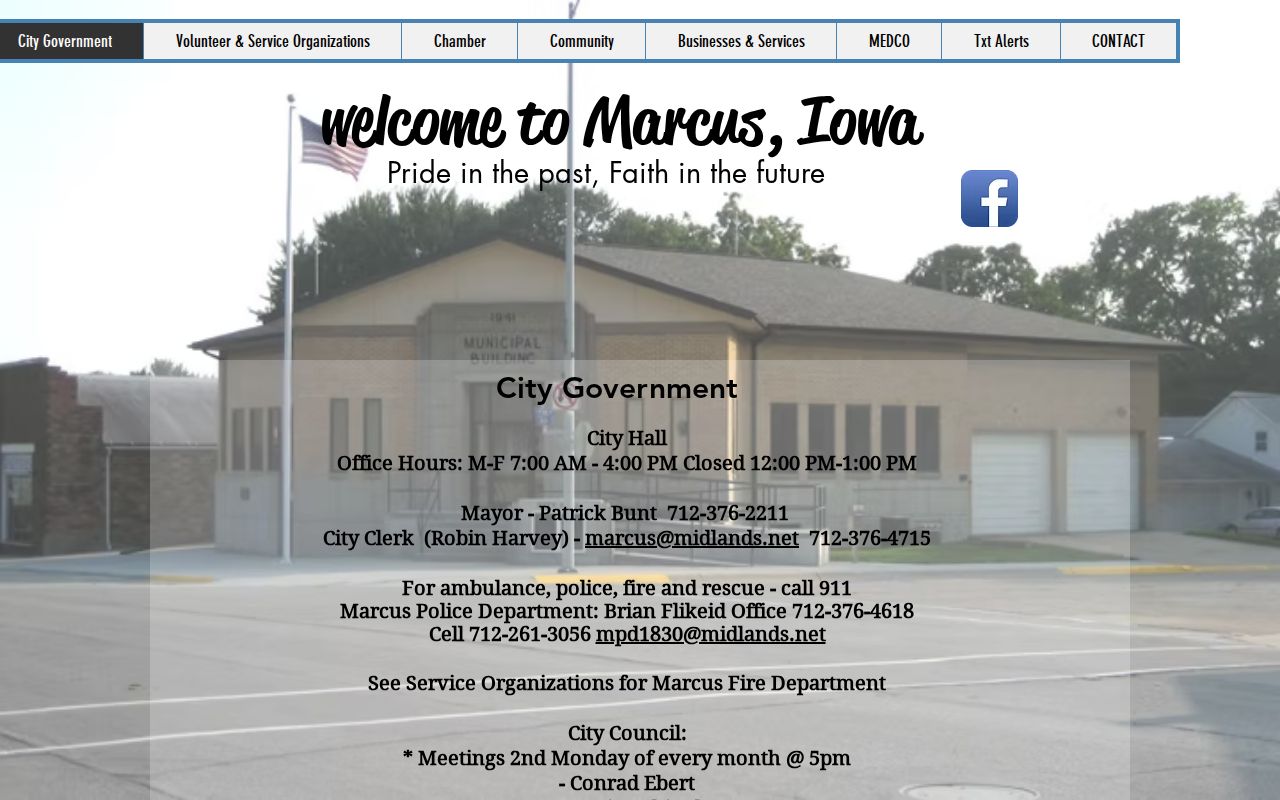
It confirms that the Marcus police office operates within City Hall rather than through a separate online records division. A caller should say whether the request concerns an incident report, public arrest facts, or another defined city record.
Records at the Marcus Police Department
Marcus Police is the first stop for records created by its officers. That includes the agency's own incident or arrest material, subject to Iowa confidentiality rules. It does not mean every narrative, witness statement, body-camera file, or investigative detail must be released. A focused request should seek the public and segregable portions, meaning material that can be separated from content the law allows the agency to withhold.
No report portal, dedicated request form, arrest blotter, published copy fee, or promised response time appears on the official Marcus pages. Send a clear request to the published police email. Include an approximate date and time, location, incident or citation number if known, the record category, desired electronic format, and contact information. Ask for a cost estimate before work begins. That detail helps Marcus staff find the right file without implying that an entire investigative folder is open.
City Hall is open on weekdays from 7 a.m. to 4 p.m. and closes from noon to 1 p.m. The lunch closure matters for an in-person record inquiry. Calling first can prevent an avoidable trip.
Note: Marcus police records and court records remain separate even when both concern the same event.
Marcus City Record Fallback
When the police channel does not yield the right city record, the Marcus City Clerk is the formal municipal fallback. Clerk Robin Harvey is listed at 712-376-4715 and marcus@midlands.net. The city also provides an official Marcus contact channel, although it is not described as a special police-report form or case-search system.
The source image below shows that general municipal contact route. It should be used to reach the city office, not to search a court docket.

A written message should identify the record sought and ask that it reach the lawful custodian. If Marcus staff did not create or keep the record, the requester may be directed to the county jail, Clerk of District Court, or another agency. That referral is useful because sending a city officer's report request to the county clerk will not produce the police narrative.
Booking and Arrest Records in Marcus
Marcus has no city jail and publishes no local arrest blotter. When Marcus Police makes a custodial arrest, booking is understood to occur through the Cherokee County Jail. For current custody information, call the jail at 712-225-6738. The county publishes no online roster, booking feed, recent-release list, or mugshot database, so direct contact is the honest first route.
Ask whether the person is currently held and whether a releasable booking identifier, related agency, or court number is available. An in-person jail inquiry goes to 111 N Fifth St in Cherokee. If immediate information is limited, a written Iowa Code chapter 22 request can seek releasable booking facts. The official jail page does not label its number as a round-the-clock record service, so no such access promise should be inferred.
A booking proves intake and custody, not guilt. A prosecutor may file a different charge, decline to file one, or later amend the case. The Cherokee County arrest search overview follows those county custody stages in more depth.
Marcus Reports Versus Court Records
The same Marcus event can create several files. Knowing the fields in each one makes the route clearer.
| Record | Marcus or County Custodian | What It Establishes |
|---|---|---|
| Incident or arrest report | Marcus Police | Allegation, officer actions, time, place, and agency data |
| Booking record | Cherokee County Jail | Intake, custody, recorded charge, bond, or release facts that are public |
| Criminal court file | Cherokee Clerk of District Court | Filed charges, docket events, lawyers, disposition, and financial entries |
| Iowa criminal history | Iowa DCI | Releasable Iowa repository information tied to submitted records |
A dismissal on the docket can coexist with an agency arrest record. Likewise, a police allegation should never be stated as a conviction. The final result belongs in the court file.
The Marcus Municipal Court File
Marcus does not operate a municipal court. Iowa abolished municipal, mayor's, and police courts when it created a unified state court system in 1973. This anchor therefore points to the real route: a Marcus ordinance or criminal matter that reaches court goes through Iowa District Court, not a city judge or local municipal-court portal. City parking payments handled administratively by a clerk should not be confused with a criminal docket search.
| Court Name | Iowa District Court for Cherokee County, Judicial District 3A |
|---|---|
| Case Types Heard | Filed criminal charges, traffic matters, and county or municipal infractions within Iowa's unified system |
| Case Lookup Channel | Iowa Courts Online, followed by the Cherokee Clerk's phone, counter, or copy process |
| What the Docket Shows | Case ID, parties, lawyers, charges, filings, disposition, and public financial entries |
| Copies & Fees | Request plain or certified copies from the Clerk and confirm the current total before ordering |
The free web docket may show an index without the underlying document. The courthouse public terminal and Clerk remain important when a pleading, order, or older file is needed.
Marcus Direct Record Model
The official 2020 Census count places Marcus at 1,079 residents, second among Cherokee County's incorporated cities. Its record process reflects that scale. There is a police office and a clerk contact, but no separate digital records bureau. Direct phone and email contact is not a lesser form of access. It is the published local route.
Marcus City Council meets on the second Monday at 5 p.m. The city's “Pride in the past, Faith in the future” header helps explain the civic setting, but council meetings are not substitutes for police files or court records. Meeting material can document city policy and oversight. Individual criminal cases still belong with the agency, jail, and unified court system that created each record.
The official Cherokee County department directory supplies the county handoff shown in the capture below.
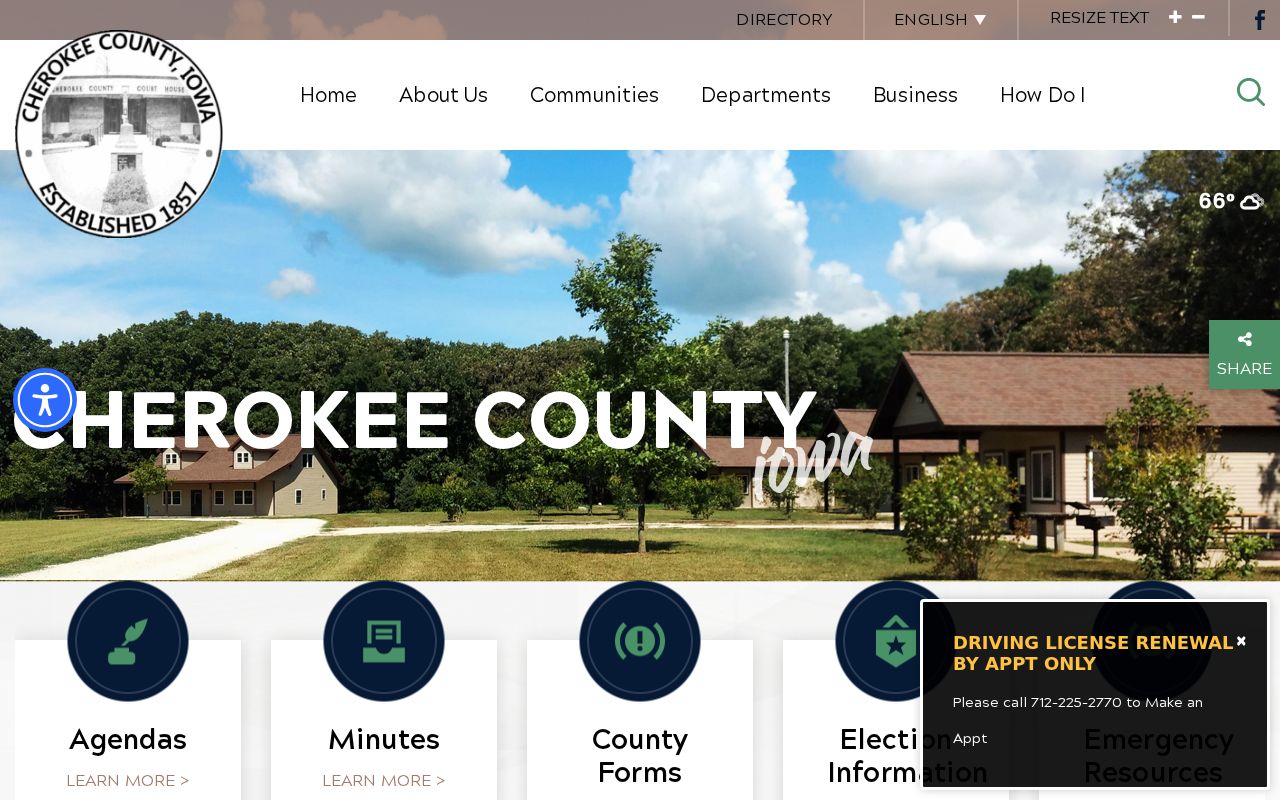
Use that directory after identifying whether the Marcus matter has reached custody or the district court. It does not replace the local police contact for an original city report.
How Marcus Records Reach the County
A fresh Marcus incident begins with Marcus Police. A custodial event creates a separate county jail record, and a prosecutor's filing creates a district court case. Fingerprint-supported arrest, court disposition, and corrections information may later reach Iowa DCI. Time and submission rules mean these sources will not always update together.
Record flow: Marcus Police Department › Cherokee County Jail and Iowa District Court › Iowa Department of Public Safety, Iowa Division of Criminal Investigation
For recent activity, ask Marcus Police or the jail first. For filed charges and outcomes, use Iowa Courts Online and the Cherokee Clerk. A statewide Iowa record check comes later and costs $15 for each last name searched. It requires first name, last name, and exact date of birth, and it is not a real-time city booking search.
Note: A missing statewide result can reflect release limits, missing fingerprints, filing lag, or a record outside Iowa.
No Marcus Arrest Blotter
The absence of an online Marcus blotter does not prove that no arrest or report exists. It means the search must move through the published contacts. Start with the police office for an officer's record. Use the jail for custody, then the court docket for a filed case.
If a web search finds no case, check spelling and timing. Iowa Courts Online requires at least two letters for a last-name search and accepts the documented percent-sign wildcard. A case may also be confidential, too old for the displayed coverage, not yet entered, or never filed after the arrest. The clerk at 520 W Main in Cherokee can help locate public documents, but cannot give legal advice.
Marcus Record Access Rules
Iowa law gives the public a right to inspect and copy open records from the lawful custodian during customary hours. It also protects defined material. Peace-officer investigative reports and criminal investigative data may be confidential, while public facts can sometimes be separated and released. Juvenile cases, unexecuted warrants, victim information, presentence reports, and expunged records may also be withheld or absent from public systems.
Key Statutes:
Iowa Open Records Law, chapter 22 gives access to public records while defining confidential exceptions and reasonable actual costs.
Iowa Code section 692.2 controls criminal-history dissemination and a record subject's access.
Iowa Code section 804.22 requires a warrantless arrestee to be taken before an accessible magistrate without unnecessary delay.
Ask for the specific record rather than “everything” about a person. If material is withheld, request the legal basis and the segregable public portion. A missing record on the web is never enough by itself to establish that no Marcus criminal record exists.
Correcting a Marcus Record Path
When reviewing your own Marcus records, compare each source according to its role. Begin with the police report for the allegation, the booking record for custody facts, and the court file for the disposition. If the court outcome is right but the Iowa repository result is wrong or incomplete, use DCI's official subject-access and correction channels rather than asking Marcus staff to change a state record they do not control.
A DCI result is Iowa-only. Without a signed release, completed deferred judgments and arrests more than 18 months old without a final disposition are not released in an ordinary check. Most simple misdemeanors and arrests that lack submitted fingerprints may also be absent. Those limits make the originating Marcus record and the Cherokee court file essential points of comparison.