
Cherokee Criminal History Checks
There is no single Cherokee city portal that combines reports, bookings, charges, and outcomes. Follow the Cherokee record from its source. The Cherokee Police route answers what an officer recorded. The county jail confirms a custody event. Iowa Courts Online and the county clerk show filed Cherokee charges and case results. DCI supplies a separate statewide Iowa history subject to release limits.
- Call Cherokee Police administration for an officer report or city arrest record, and identify the incident date, location, and report category.
- Use the City of Cherokee contact form or City Clerk when a written city-record request needs routing and no police request form is published.
- Call Cherokee County Jail for current custody or booking information because the city publishes no jail or arrest blotter.
- Search Iowa Courts Online and contact the Cherokee Clerk of District Court for the filed case, public documents, or an older record.
- Order an Iowa DCI check when the question calls for releasable statewide Iowa history rather than one Cherokee incident.
Use an exact name and date range when known, but do not treat a missing Cherokee result as a clean-record finding. Spelling, entry lag, confidentiality, an older file, or a matter that never reached court can each explain the gap.
Three Cherokee Record Counters
Cherokee's key records sit at three central addresses. Police reports begin at 239 West Maple Street. Court cases belong with the Clerk of District Court at 520 West Main Street. Booking and sheriff records are handled at 111 North Fifth Street. These offices are close in distance but hold different documents, so walking into the nearest government building may still lead to a referral.
The Cherokee City Clerk at 416 West Main Street is the municipal recordkeeping fallback when no direct police records form or email is published.
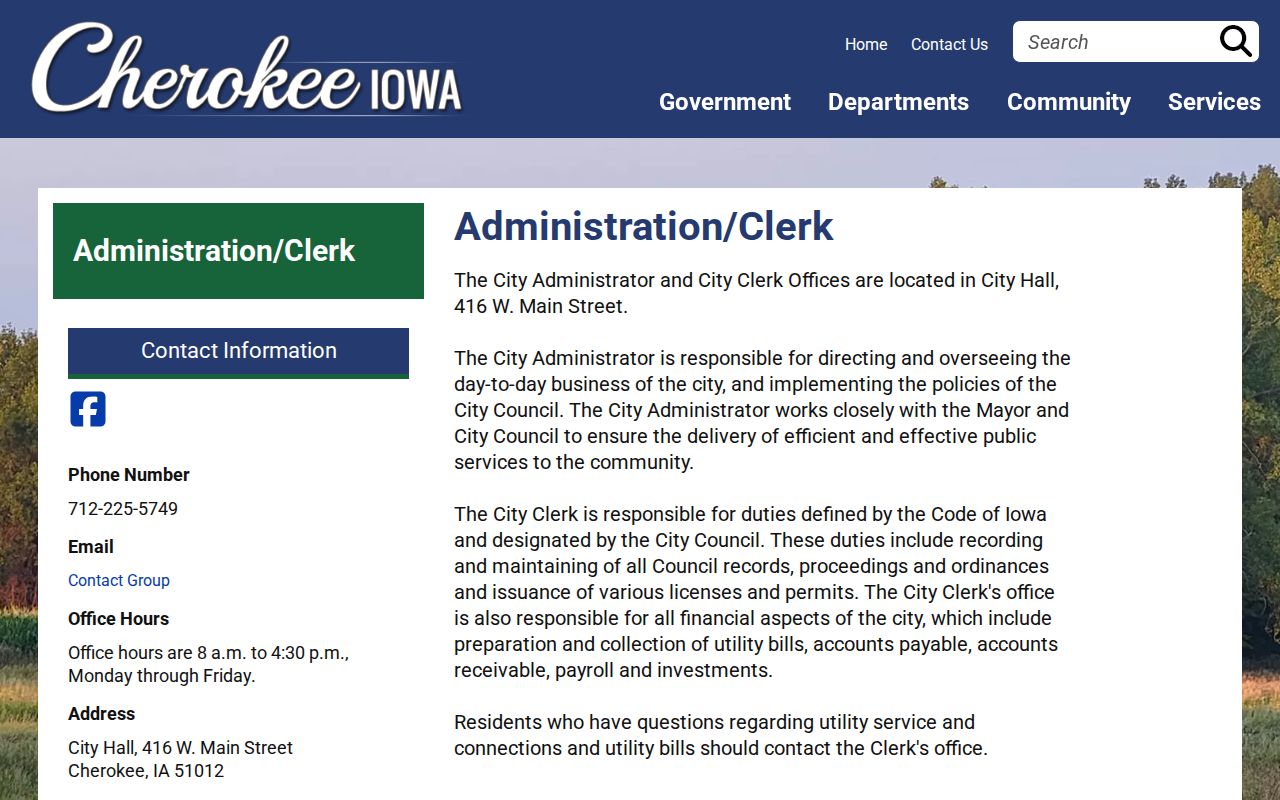
The clerk can route a Cherokee public-record request, but the Cherokee City Clerk does not replace police as custodian of an investigative report or the county clerk as custodian of a criminal case file.
Records at Cherokee Police Department
The Cherokee Police Department is at 239 West Maple Street, Cherokee, Iowa 51012. Administration is available at 712-225-6464 on weekdays from 8 a.m. to 4 p.m. The department names Chief Nate James. After hours, county communications takes calls at 712-225-6728. Use 911 for an emergency, not for a routine records question.
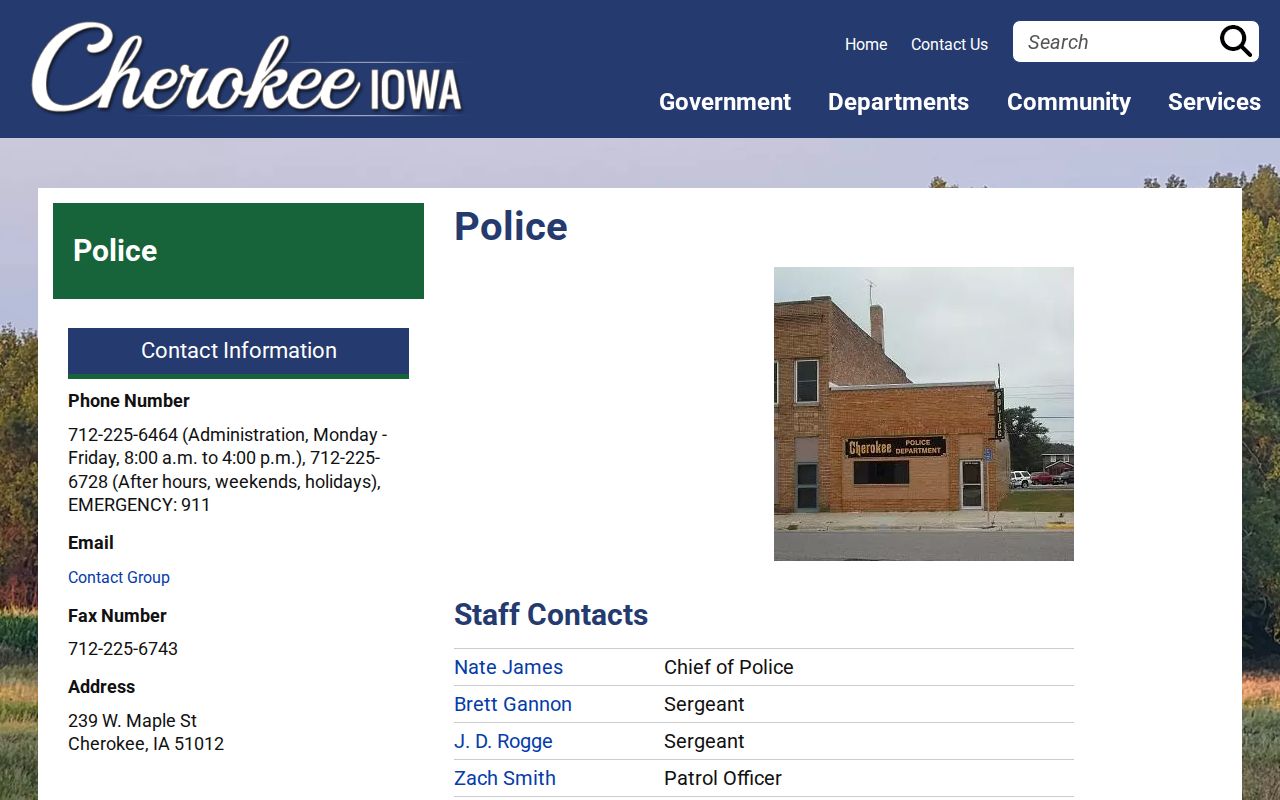
Cherokee Police files can include an incident narrative, officer action, a citation, an arrest record, and related investigative material. Cherokee records do not establish guilt. Iowa law can keep peace-officer investigative reports or criminal investigative data confidential, while releasable facts may be separated and produced. Ask for the specific record class and public portions rather than demanding an entire case file.
Cherokee Police Department
239 W Maple St
Cherokee, IA 51012
712-225-6464
Weekdays, 8 a.m.–4 p.m.
Cherokee Police Record Request Route
Cherokee Police publishes no dedicated report request form, public records email, report portal, copy fee, or promised turnaround. A notarized Authorization for Release document found on the Cherokee city site serves a personnel-style purpose and should not be used as if it were a police public-record form. Call Cherokee Police administration first to confirm where and how the request should be delivered.
When a written Cherokee route is needed, the official City of Cherokee contact form or the Cherokee City Clerk at 416 West Main Street, 712-225-5749, and clerk@cherokeeiowa.net can route the request.
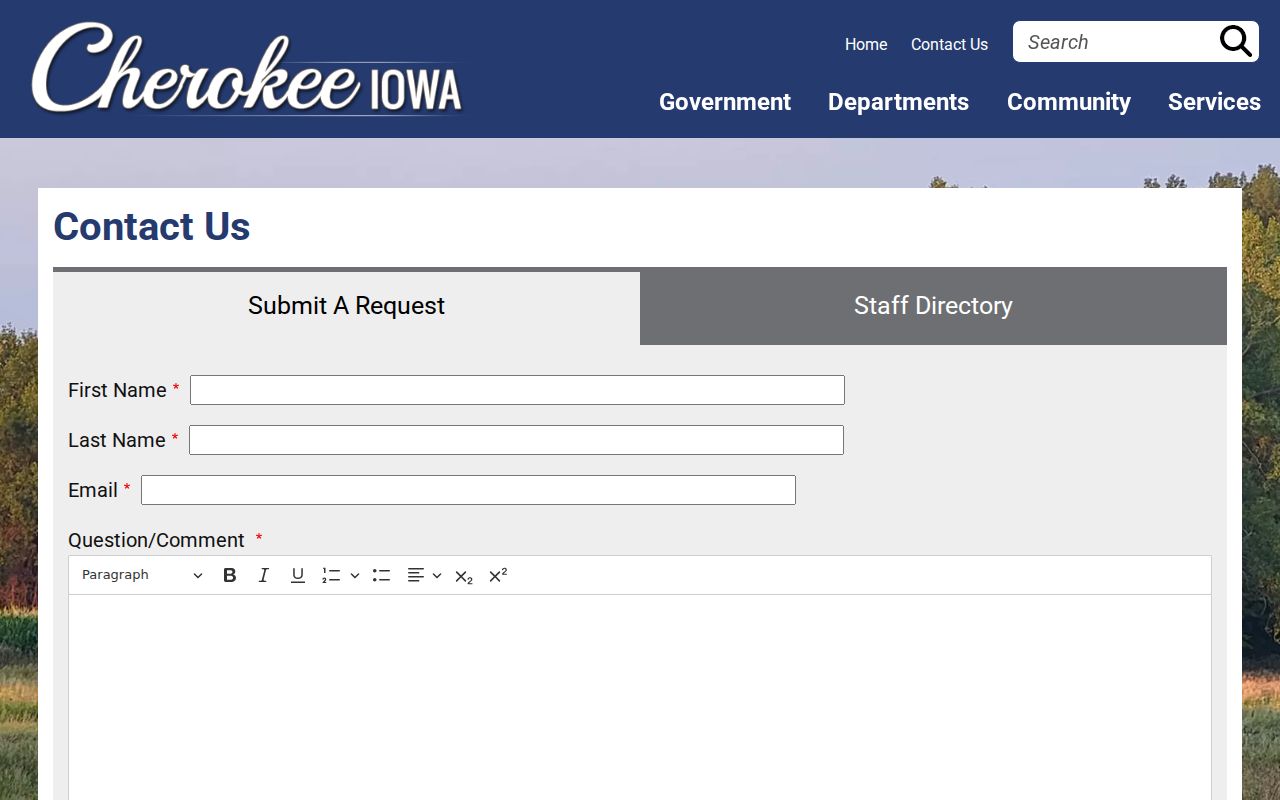
Describe the date, approximate time, location, incident or complaint number, requested record categories, preferred electronic format, and contact information. Ask for a cost estimate before work begins and request the legal basis for withheld material.
Booking and Arrest Records in Cherokee
A Cherokee police arrest and a Cherokee County booking are separate events. Cherokee city code requires the police chief to keep a record of arrests, so the originating Cherokee record belongs with CPD. No Cherokee city jail is published. Based on the official allocation of duties, custody is routed to the Cherokee County Jail while CPD retains the originating report.
Cherokee County publishes no online jail roster, recent-booking log, mugshot search, or release list. Call the jail at 712-225-6738 or visit 111 North Fifth Street for current custody and booking questions. The official county site does not promise that this is a round-the-clock record line, so confirm what can be released and when. A written request under Iowa Code chapter 22 is the fallback for releasable booking data.
Once a criminal case is filed, the court docket can show the filed charge, case ID, parties, lawyers, proceedings, disposition, and financial entries. The police allegation may differ from the prosecutor's formal charge. Neither an arrest nor a booking proves guilt.
After-Hours Cherokee Police Records
County communications at 712-225-6728 handles after-hours Cherokee police calls. That line is useful for reaching the correct Cherokee public-safety agency, but it is not described as a dedicated police-record service. A routine Cherokee report-copy request is best made during the published administration hours. An urgent safety matter belongs with dispatch or 911 as the facts require.
For a recent arrest, separate the questions. Communications may identify the responding channel, the jail may address custody, and police administration may later handle the incident record. Searching the court docket the same night can fail because a filed case ordinarily takes one business day to enter public search results.
Note: A same-day blank court search does not disprove a Cherokee arrest or citation.
The Cherokee Municipal Court File
Cherokee does not operate a municipal court. Iowa uses a unified state court system, and city citations or ordinance matters that become court cases proceed in the Iowa District Court. The anchor refers to the city-level case route, not to a separate Cherokee tribunal. Search the public docket through Iowa Courts Online and choose Cherokee County when narrowing results.
| Court Name | Iowa District Court for Cherokee County, Judicial District 3A |
|---|---|
| City Case Types | Filed criminal, traffic, citation, and qualifying ordinance matters from Cherokee |
| Case Lookup Channel | Iowa Courts Online, then the county clerk's phone, counter, or public terminal |
| What the Docket Shows | Case ID, parties, lawyers, charges, filings, disposition, and financial entries |
| Copies & Fees | Request plain or certified copies from the clerk and confirm the current total before ordering |
The Cherokee Clerk of District Court is at 520 West Main Street, Drawer F, Cherokee, Iowa 51012, and can be reached at 712-225-6744. Published office hours are generally 8 a.m. to 4:30 p.m. on weekdays, though the office cautions that it may close during lunch. The courthouse public terminal can display public documents not available in the free basic web view.
Cherokee Arrest Recordkeeping Duty
The current Cherokee city code directs the police chief to keep an arrest record. That local duty explains why the Cherokee Police channel remains important even after the person has left city custody or a court case begins. The arrest record documents the Cherokee event. The jail record documents intake. The court file documents charges, hearings, and outcome.
- Arrest record
- The police record of custody under legal authority, including the claimed basis and agency action.
- Booking record
- The county jail's administrative intake and custody event after transport.
- Disposition
- The court's recorded outcome, such as dismissal, acquittal, guilty plea, or verdict.
A request sent only to the court will not produce the officer's full investigative narrative. A request sent only to police will not provide the final court judgment. Ask each lawful custodian for the part it holds.
How Cherokee Records Reach the County
Cherokee Police create the incident and arrest record. If custody follows, Cherokee County Jail creates a booking event and generally captures fingerprints and a photograph. The County Attorney can file a Cherokee complaint or trial information, and the clerk maintains the resulting Iowa District Court case. Court dispositions and corrections information can then flow to the Iowa Division of Criminal Investigation.
Record flow: Cherokee Police Department › Cherokee County Jail and Iowa District Court › Iowa Division of Criminal Investigation
The sequence guides the Cherokee search. CPD is the first source for the allegation and officer report. The jail is the source for a recent custody question. The clerk is the source once Cherokee charges are filed. DCI is a later statewide repository check, not a live city booking service. Fingerprints also matter because DCI explains that an arrest unsupported by submitted fingerprints will not become an Iowa criminal-history entry.
Cherokee Police Reports Versus Cases
The same event can look different across two official records. A police report describes an allegation and investigation. A court docket shows what prosecutors filed and how the judicial process ended. An officer's initial offense description may change, charges may be dismissed, or no case may be filed. Keep the source label attached when sharing or interpreting either record.
| Question | Police Record | Court Case |
|---|---|---|
| Who keeps it? | Cherokee Police Department | Cherokee Clerk of District Court |
| What does it center on? | Incident, allegation, officer action, and arrest | Filed charge, docket events, disposition, and judgment |
| How is it requested? | Police call or Chapter 22 city request | Iowa Courts Online or clerk request |
| What can limit access? | Investigative, juvenile, victim, and protected data | Confidential, juvenile, sealed, or restricted court material |
For the wider county court process, use the Cherokee County court case lookup. Keep the city request focused on the originating Cherokee police file.
Cherokee Court Records and History
The split between city and county records reflects Cherokee's role as county seat. Cherokee County was created in 1851, and Cherokee became the seat in 1861. Its first courthouse also served as a public hall and schoolroom. When the railroad established New Cherokee in 1870, settlers moved buildings, including the courthouse, about a mile and a half toward the rail line.
A Romanesque courthouse followed in 1892. Voters approved a replacement bond in 1964 after two failed votes, and the present courthouse was dedicated in 1966. The official Cherokee County courthouse history gives that civic setting. Today, court records remain at West Main, while city police and the county jail keep their distinct files at separate addresses.
The city's archive also preserves local accounts of the Fountain House pillars, Senator Guy Gillette, and two Buffalo Bill visits. Those historic sources serve a different research need than current criminal records, but they show why the city and county archives should not be treated as one database.
Cherokee Record Access Rules
Iowa law begins with access through the lawful custodian, then applies record-specific limits. Cherokee Police can withhold protected investigative data. The court excludes juvenile and confidential cases from public search. Unexecuted warrants, presentence investigations, victim information, and protected identifiers can also remain restricted. Ask for segregable public portions, which means parts that can be released after protected material is removed.
Key Statutes:
Iowa Open Records Law, chapter 22 establishes inspection and copy rights while listing confidential exceptions.
Iowa Code chapter 692 controls DCI criminal-history dissemination and subject access.
Iowa Code chapter 901C makes qualifying expunged records confidential under its conditions.
A DCI check costs $15 for each last name and requires an exact date of birth. Without a signed release, completed deferred judgments and arrests more than 18 months old without a final disposition are not released. It covers Iowa only. For a city event, those limits make the CPD report, jail record, district court file, and DCI result complementary rather than interchangeable.