
Criminal Court Cases in Cherokee County
Every Cherokee County criminal prosecution belongs in the Iowa District Court. Magistrates handle simple misdemeanors, traffic matters, county and city infractions, preliminary hearings, warrants, and protective orders. District associate judges may hear serious and aggravated misdemeanors as well as class D felonies. District judges can hear every case type. This division of work affects the judicial officer, but not the basic place to search for the public docket.
Iowa ended municipal, mayor's, and police courts in its 1973 unified-court reform. Cherokee, Marcus, and Aurelia therefore have no separate municipal criminal portal. City ordinance prosecutions route to District Court, while a city clerk remains the right office for a parking-only matter. The Cherokee County Clerk of District Court is the court-file custodian, while the Cherokee County Attorney handles prosecution rather than public file custody.
Cherokee County Court Wildcard Searches
The Iowa Courts Online name search requires at least two letters in the Last/Firm Name field. Exact spelling matters. The percent sign is the system's supported wildcard, and a first-name initial is entered without a period. AND asks for a case in which both named people appear; OR returns a case containing either person.
The official Iowa Courts Online portal shown below is the statewide starting point for a Cherokee County case lookup.
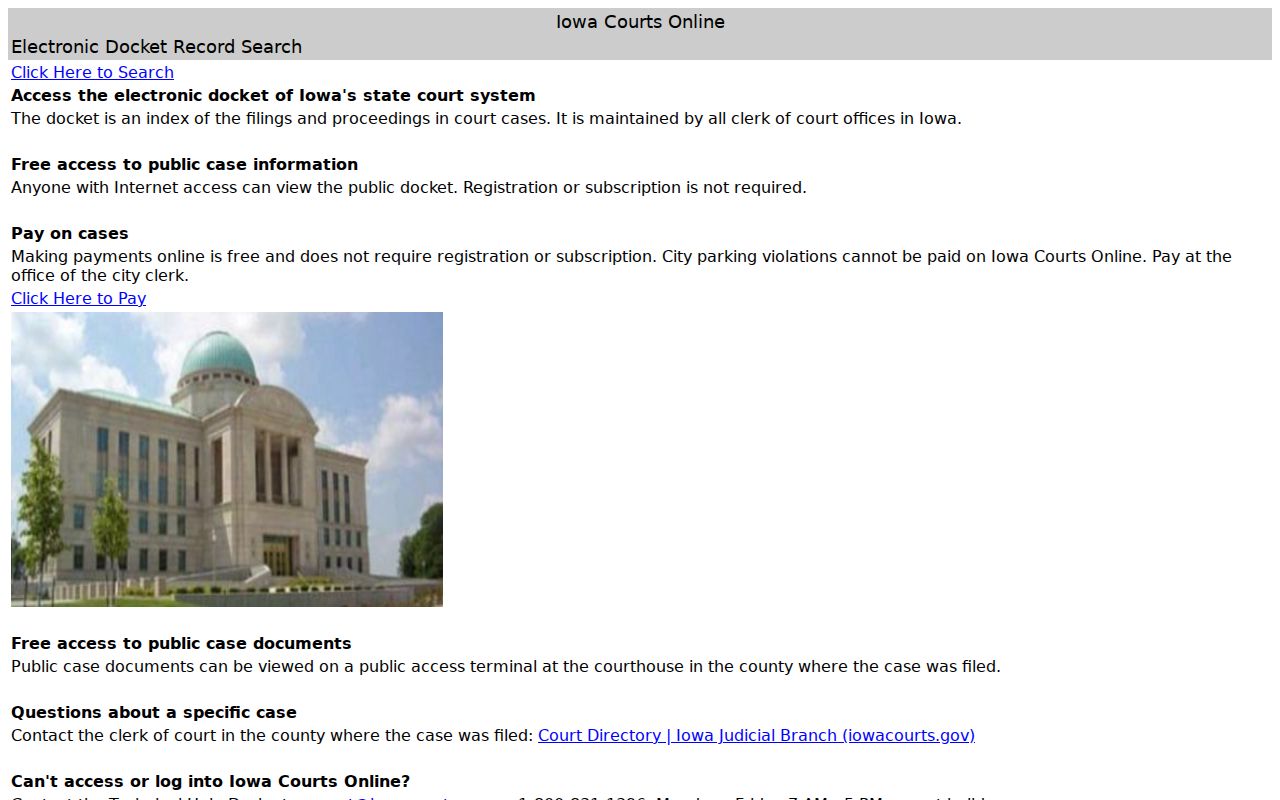
Selecting Cherokee in the County field cuts down unrelated matches. A missing result may reflect a spelling issue, a filing delay, an older file, or a confidential case rather than the absence of any court record.
Cherokee County Case Record Searches
Basic public docket access is free and needs no registration. Trial cases after 1998 are included, along with some earlier cases. A new case ordinarily takes one business day to enter results, after which public docket data update in real time. Use only enough identifying data to find the right case, and never reproduce a date of birth from an official search screen.
- Open Iowa Courts Online and choose a person-name, citation, or case-ID route.
- Enter at least two last-name letters, apply the percent wildcard if needed, and select Cherokee County.
- Narrow by first name, role, case type, or the exact case identifier when known.
- Open the matching docket and compare the filed charge, dates, parties, disposition, and financial entries.
- Call or visit the Cherokee County clerk for public documents, older files, plain copies, or certified copies.
The most useful controls from the official help material are summarized here.
| Field Label | Type | Required | Notes |
|---|---|---|---|
| Last/Firm Name | Text | Yes for name search | At least two letters; exact spelling; % wildcard |
| First Name | Text | No | Enter an initial without a period |
| County | Dropdown | For case-ID search | Select Cherokee to narrow results |
| Case Type | Dropdown | For case-ID search | Use with the county and case ID |
| Case ID | Text | No | Full trial ID has 17 characters and uppercase letters |
| Citation Number | Text | No | Separate route for a known citation |
Cherokee Dockets and Court Documents
The public web docket is an index of proceedings, not always the complete set of documents. It can show the case title, parties, lawyers, criminal charges, filings, dispositions, and amounts paid. Some links and advanced functions require an Online Search subscription or access through the public terminal. Seeing a filing name without an open document does not prove that the document is confidential.
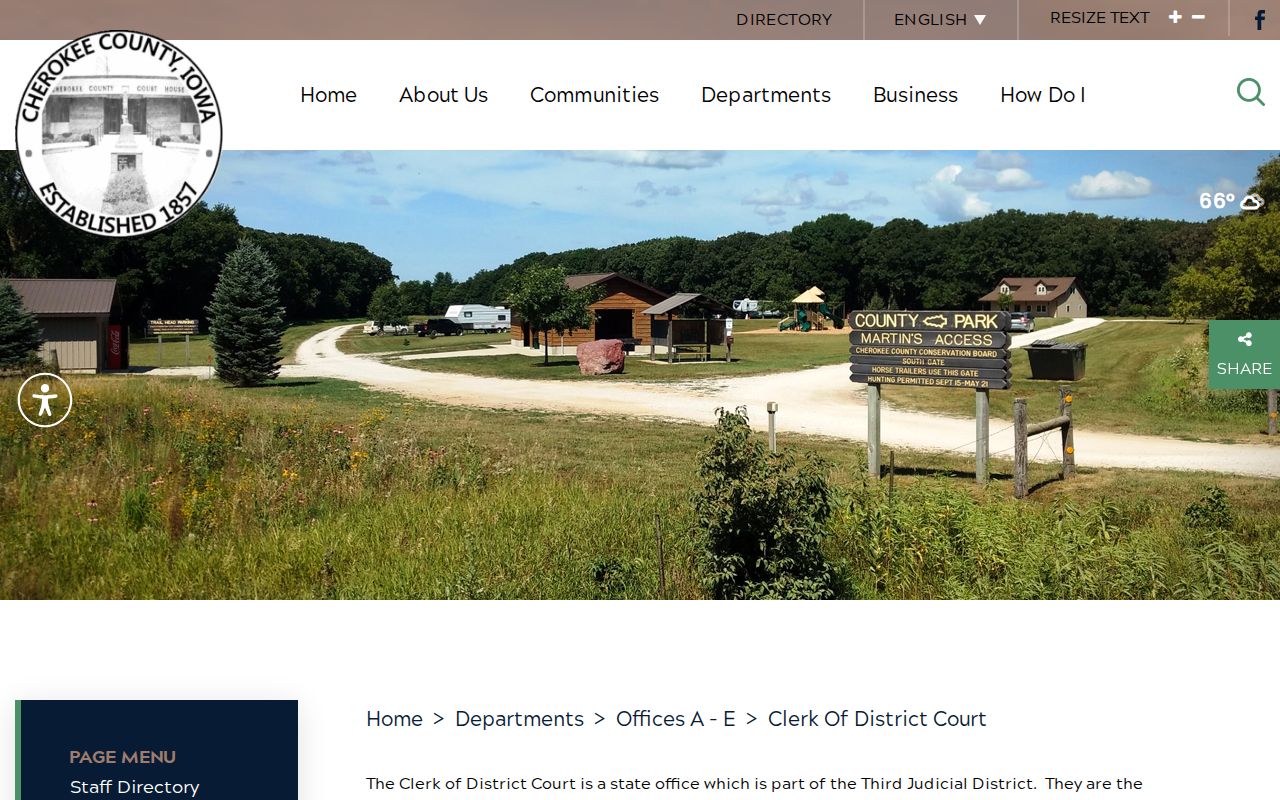
The Cherokee County Clerk of District Court provides the full-file fallback at 520 West Main Street, Drawer F, Cherokee, Iowa 51012. The phone is 712-225-6744, and the office publishes weekday hours of 8:00 a.m. to 4:30 p.m., with a warning that it may close during lunch.
The official Cherokee County clerk page shown here identifies the local office that maintains court case records.
Ask for a record by case ID, document title and date when known, desired format, and plain or certified status. Request a price estimate before ordering. The Judicial Branch guide reports a plain-copy charge, but current totals and certification charges should be confirmed with the clerk.
What a Criminal Case File Contains
A Cherokee County criminal case file follows the charge that the prosecutor actually filed. That charge can differ from the allegation recorded at arrest. The docket then places motions, hearings, rulings, pleas, trial activity, judgment, sentence, and later financial or supervision events in time order. The underlying police narrative stays with the originating agency rather than becoming a clerk-held report.
| Case Number & Court | Identifies the Cherokee County matter, case type, and Iowa District Court. |
|---|---|
| Charging Document | Shows a complaint, trial information, or indictment and the filed counts. |
| Docket Entries | Lists filings, orders, notices, and other events by date. |
| Hearing Dates | Shows scheduled and completed public court events when available. |
| Disposition & Judgment | States whether a count ended in dismissal, acquittal, plea, or judgment. |
| Sentence & Conditions | Records the court-ordered result and public financial entries. |
Note: The public docket describes a prosecution; it does not replace the separate arrest, booking, or statewide DCI record.
EDMS Is Not Cherokee Case Search
Iowa EDMS is the electronic filing service. Its account sign-in, payment policy, and filing tools do not make it the public docket search. A person seeking a case should begin with Iowa Courts Online, while a filer follows the applicable EDMS process. Confusing the two systems can lead to an unnecessary account screen without producing the requested case.
The official EDMS screen below helps distinguish the filing channel from Cherokee County court case access.
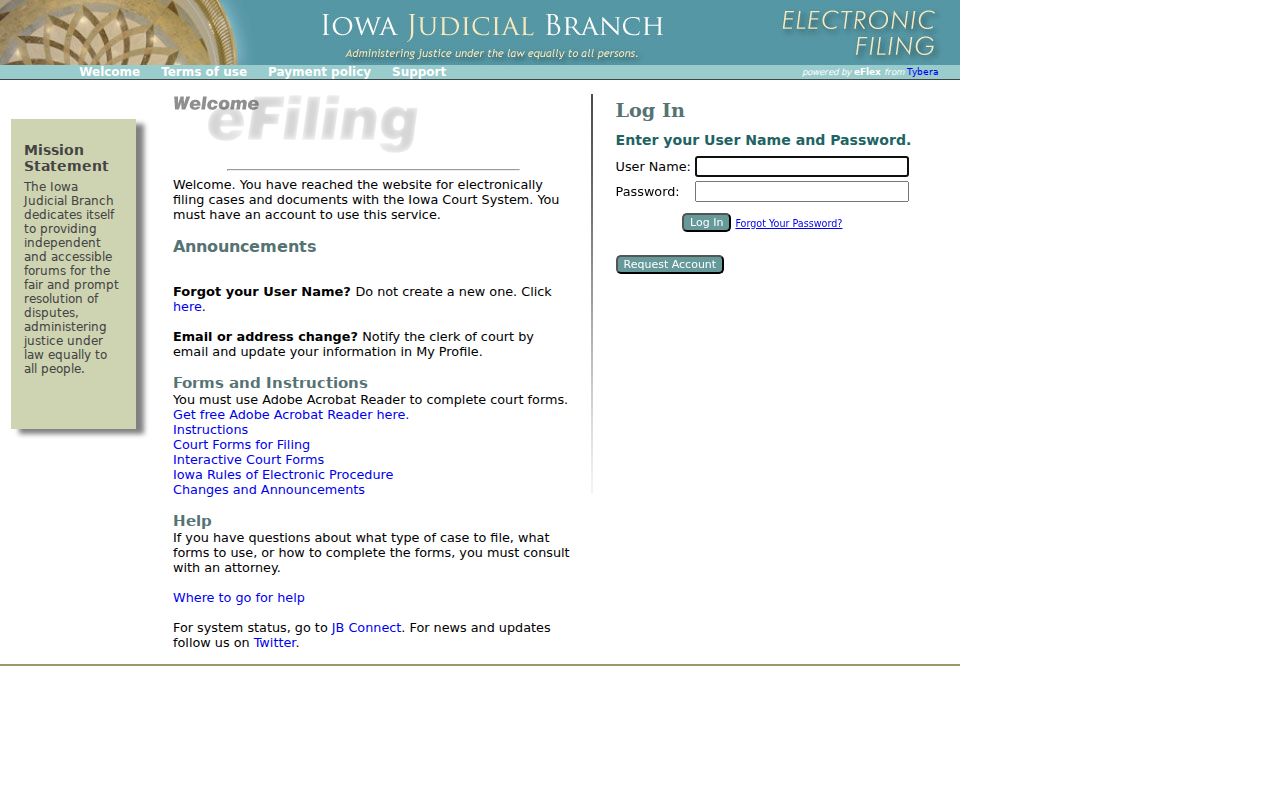
Anyone may make an eligible case payment online without buying a case-search subscription. City parking violations are different and go to the city clerk. These payment routes do not expand access to a confidential case or a restricted document.
For Cherokee County record access, keep three tasks separate. Iowa Courts Online finds the public docket, the Cherokee County terminal or clerk supplies public documents, and EDMS accepts authorized filings. A sign-in prompt is a clue that the user reached the filing system, not proof that a Cherokee County case is unavailable. Return to the public search before calling the clerk, then give staff the case ID if the docket can be found.
Criminal Case Stages in Cherokee County
A criminal case can begin with an arrest or a chapter 805 citation. The complaint and initial appearance state the basis for the matter, then the prosecutor decides what charge to file. Iowa requires a person arrested without a warrant to be taken before the nearest or most accessible magistrate without unnecessary delay. The law does not support a blanket local promise of a fixed 24-hour or 48-hour limit.
Case flow: Charges Filed › Arraignment › Pretrial › Plea or Trial › Disposition › Sentencing
Arraignment receives a plea. Pretrial entries can include motions, notices, discovery-related activity, and hearing dates. A plea or trial leads toward disposition, and sentencing follows a conviction when it is not imposed at the same event. An appeal or supervision matter may add later docket activity. Read each count separately because one case can contain different outcomes.
Cherokee County City Cases
No separate Cherokee, Marcus, or Aurelia municipal court file exists. Police may issue the citation or create the incident record, but a prosecuted city ordinance or criminal matter reaches Iowa District Court. Search the same Cherokee County docket and use the county department directory to reach the clerk for court documents. For parking-only matters, contact the city clerk because those payments do not run through Iowa Courts Online.
This unified route prevents a common dead end. A city police department is the right custodian for its own report, while the county clerk holds the filed prosecution. A citation may also create a court case without any jail booking, so the absence of a custody event does not rule out a searchable docket.
The same boundary applies to warrants. A Cherokee County court can issue the warrant, and law enforcement executes it, but an unexecuted warrant may remain confidential. A broad public docket search is not a safe way to decide whether one exists. Direct a case-specific question to the issuing court or the responsible agency without treating silence from the web portal as an answer.
Older Cherokee County Court Records
Public trial cases after 1998 form the core of Iowa Courts Online, and some older matters were entered electronically. When a well-formed name search finds nothing, change the spelling or wildcard before drawing a conclusion. Then call the filing county's clerk. The courthouse terminal and older clerk-held files may answer a question that the free statewide web view cannot.
A request should give the person's name, an approximate filing year, the case type if known, and any prior case identifier. The clerk cannot give legal advice, but staff can address record location and copy access. For the wider flow from an arrest into court, the Cherokee County arrest search explains why the booking and case may not appear at the same time.
Access Rules for Case Records
Iowa Code chapter 22 supports inspection and copying from a lawful custodian, but specific law and court rules protect some material. Juvenile and sealed cases, presentence investigations, unexecuted warrants, commitments, deferred-judgment dockets, victim identifiers, and records sealed by law or order may not appear in the public search.
Charging pleadings are generally public. Minutes of testimony attached to an indictment or trial information are restricted, so the public nature of the charge does not open every attachment. Iowa Court Rule chapter 16, Division VI governs electronic public access. If a public case appears but a document does not, ask the Cherokee County clerk about terminal viewing or a copy before assuming it is sealed.
Note: A missing online case may reflect confidentiality, age, delay, or spelling, and is not proof that no record exists.